11/28/2007, 7:55 pm
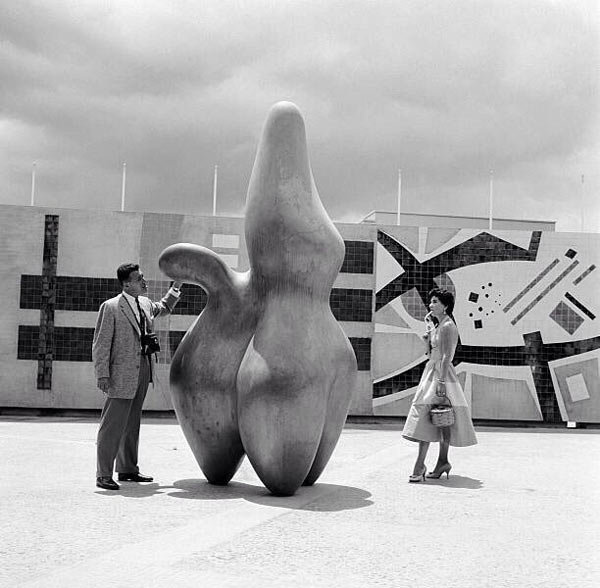
Shockwaves are reverberating throughout the art world following the amazing discovery of abstract ancient Greek statues and paintings that resemble today's modern art and apparently are its long-lost forerunners.
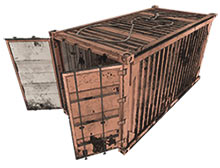 After six years of excavation archeologists uncovered a metal container.
After six years of excavation, a team of archeologists from Columbia University has uncovered a giant metal container, buried deep within the earth under Kakanapolis, a suburb of Athens. The artifacts found within have been dated by specialists to the period between 500 and 300 BCE, corresponding to the Golden Age of Athenian culture, the days of Plato and Aristotle.
Greek statues in the days of Plato and Aristotle.
Professor Dan Browny is convinced that "The new discovery will revolutionize the way public thinks about art and all of Western civilization, and silence any further false claims about the alleged superiority of Western culture."
"Ancient art was not only vanguard-oriented, it was also government-subsidized," Dan Browny writes in an article describing his discovery. "It was just as easy to get a grant from the National Endowment for the Arts in Athens as it is today in Syracuse, New York. A famous example was a controversial project around 490 BCE that sponsored public defecation on a sketch of the Pythagorean theorem. It was hailed by critics of the time as a synthesis of art and science."
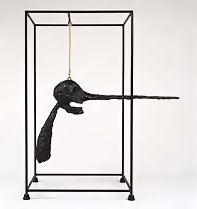
This ancient Greek sculpture (catalog #56Z82.3) is believed to have been on display in the Parthenon itself.
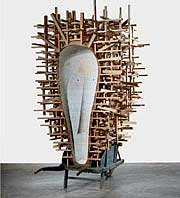
The realm of mixed media is best represented by catalog #76E38.2.
Paintings include a lively work, nicknamed Eternity by the research team, that once adorned the living room of Alexander the Great's Macedonian ranch.
Thaddeus Thistlebrain of the Center for Progressive Art in Washington is preparing an article exclusively about Eternity. "The resemblance to the work of Jackson Pollock is astounding," he notes. "Further evidence that our own abstract expressionists are deeply rooted in the timeless vision and expansive aesthetic of the ancients."
 Dan Browny: "Ancient art was not only vanguard-oriented, it was also government-subsidized."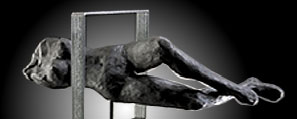

Columbia University's Morningside Heights campus was abuzz with discussion. Peggy Hooperdink, an architecture student from Flushing, Queens, could hardly contain her enthusiasm. "This is, you know, like, totally awesome. I can't stand all those columns and that everything has to be proportional. So, you know, like the whole Greek thing is a fake. I knew it all the time."
Researchers dismissed rumors picked up by the Fox News channel that what the archeologists had dug out was a garbage container, and that it also had a papyrus scroll attached on the inside. The scroll allegedly described the artifacts as a load of "useless junk resulting from a failed government program aimed at creating a class of state-subsidized artists," leading to a far-fetched conclusion that the container might very well be a capsule sent by the ancients to the future, warning us against experiments with government grants to hemlock-addicted artists.
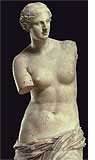 "Venus de Milo" is a fabrication
 The original "Venus de Milo" found inside the giant metal container.
 Napoleon was also duped.
Apparently, Machiavelli disseminated rumors of the statue's ancient provenance. His goal was to show that the thoroughly bourgeois, academic style prevalent in the Florence of his day was inspired by "rediscovered treasures" of hoary antiquity, representing a sort of "renaissance" of that culture.
"It's all hooey, just as we expected," explained Shlock-Jones. "Renaissance, shmenassance. Machiavelli was a White male chauvinist, and this supposed 'art' was designed to advance his ideology of cultural imperialism. For centuries, all of Europe has been duped, even Napoleon."