Since this is an interview with me, I'm reposting it with minor corrections in the parts where I'm quoted directly, in order to clarify my points better. Had I used the teleprompter during the interview, I could have just said, "Let me be clear!" and all my points would have been sorted and clarified automatically. Unfortunately, that day my teleprompter was at the corner shop with some ignition and radiator problems, hence the necessary edits.
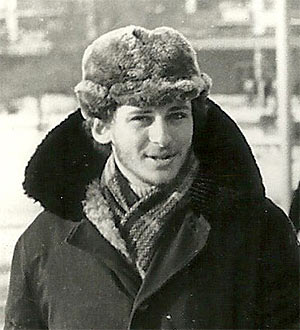
Also, since the interview touches on my "young adult" years as an agitprop artist, I'd rather use a picture from those days instead of the more recent ones they used.
Oleg Atbashian, a Florida resident and conservative author who runs the political parody site “The People's Cube”, worked as a propaganda artist in the former Soviet Union, when he was a young adult living in Siberia.
Now that he's watching the debate unfold about Russia invading his native Ukraine, he said he can see the Russian rumor influence operation is making its way into Western media the way it did during the Cold War.
He has noticed, for example, the Russian narrative about the Ukranian opposition movement as “Nazis” and “Fascists” appears to be finding itself in Western outlets and American blogs.
“The pro-Kremlin propaganda is still being spread through the usual leftist, anti-war channels. Only this time, it has nothing to do with Communism. It has nothing to do with anti-war sentiment. It has everything to do with Russian national interest and Russian nationalism and Russian dominance in the region. The same people the same town the same figures are being used to plant this information,” says Atbashian, comparing it to the Tea Party being maligned as racists in the U.S.
Conservative talk radio host Rush Limbaugh noticed the coverage as well. During one of his segments last week, Limbaugh played a CNN clip with Wolf Blitzer citing the Ukranian protesters as “neo-Nazis” “anti-semitic” and “anti-Russian.”
Atbashian has an interesting story about how he came to be part of the Soviet propaganda machine – and eventually landed in the U.S. as a conservative activist.
“It sounds a little grander than it was. I was 23 years old.I wanted to be an artist," Atbashian said, "but it was hard to get anywhere in that profession if one wasn't a member of the Artist Union. So the only outlet for people like me was to become a maker of visual motivational and agit-propaganda art that was in the street and in the interiors of companies.”
Atbashian compares the work he did to many billboards seen in the U.S. “They kind of brighten up the landscape especially around the cities and along the highways. In the Soviet Union we didn't have any of that. We had motivational propaganda, so you would've seen a poster of a worker calling comrades to work in order to fulfill the five-year plan ahead of schedule to build Communism. Those were the only bright spots in the otherwise drab landscape. Everything else was dark and dated,” he said noting that most people would look at it as decorative art.
“Towards the end during the collapse of the USSR, most people didn't believe in the propaganda. It was pretty cynical and everybody was making jokes about Communism,” he said.
Atbashian left Ukraine in 1994 explaining that while it was easier to leave the country after the collapse of the USSR, Western countries like the United States were not accepting many Ukranians.
“Getting a visa at the American embassy was more complicated than getting an exit passport and so I was luckier than others, but a large portion of people who applied for entry visas to the U.S. were not approved," he said.
The graphic designer says that the KGB “used to be a great rumor machine, who received much mileage from the rumors they started." According to Atbashian, the FSB, which is a successor to the KGB in Russia, “is operating the same way and so the channels the KGB had are still in place in Europe and the United States. Whatever useful propaganda needs to be spread is being spread.” Atbashian points to even less mainstream American sites where he believes information could be planted.
He said, “I have always suspected Alex Jones of being a tool. The positioning of certain facts. The way he was describing American involvement in the world stage was always suspect to me, but now he's taken an active role in this conflict from the very beginning. There are postings over at InfoWars, for instance, that sounded like direct translations from Pravda editorials, even though the authors had American-sounding names. A lot of articles that I read from Western sources about Ukraine had the voice of Russian chauvinism. “
“It was very surprising. Why would suddenly people who are not Russian espouse these views that are benefiting the Kremlin?” he said.
3/12/2014, 12:22 pm
Commodore Snoogie Woogums
Comrade Director!!!!!!
I see the reichwing dupes at Breitbart can't even figure out that you were actually infiltrating that den of conservative heathens under the guise of a so called 'interview'......Bawahhahahaaa!!!!
Awesome interview. I can't imagine that the picture of the man in 80's could have ever foreseen that he would be a U.S citizen one day, and not just any U.S citizen, but a U.S citizen that truly makes me feel proud to call a fellow American and a true real American patriot.
3/12/2014, 1:34 pm
Anon E Mouse
Commodore Snoogie Woogums wrote:
Awesome interview. I can't imagine that the picture of the man in 80's could have ever foreseen that he would be a U.S citizen one day, and not just any U.S citizen, but a U.S citizen that truly makes me feel proud to call a fellow American and a true real American patriot.
I agree wholeheartedly! I checked the Breitbart comments - loved these two that were (fortunately) together:
Comrade Square... Since you are in Florida, if you ever get to the Villages - please stop by my Polish-Czechoslovakian matka and say "Cześć" I really ought to get her your book - then you could autograph it for her.
3/12/2014, 5:36 pm
Red Square
Commodore Snoogie Woogums wrote:I can't imagine that the picture of the man in 80's could have ever foreseen that he would be a U.S citizen one day, and not just any U.S citizen...
You're right! I was thinking that myself as I was posting that picture. I had NO IDEA at the time. Funny how life turns out sometimes.
3/12/2014, 5:39 pm
Red Square
anonemous1 wrote:Comrade Square... Since you are in Florida, if you ever get to the Villages - please stop by my Polish-Czechoslovakian matka and say "Cześć" I really ought to get her your book - then you could autograph it for her.
In fact, I spoke before the Villages' two Tea Party groups twice - and if your mom attends their meetings, she may have seen me there. I could have made a shout-out from the podium if I had known her name.
The Villages is a perfect retirement community, sort of like heaven on earth for the seniors. I started my speech there by remembering how, when I was a little kid and I heard stories about the coming wonders of communism, I imagined our future life to be pretty much like what they have now in the Villages. Except it never happened in the USSR, but it happened in America without the need to suffer a dictatorship, sacrifice, kill, and prosecute the non-compliant. Even the Soviet elite ("the people's servants") that lived way better than the rest of the people, didn't approach the level of comfort enjoyed by the middle-class American seniors in the Villages.
3/15/2014, 6:34 pm
Juche Couture
speaking from Pyongyang, Grorious Reader Kim Jong Un said, "Who is this Oreg Atbashian? And that picture! Rooks rike a damned ronghaired firthy hippy, if you ask me. He not have my good rooks and sexifur hair"
3/17/2014, 7:12 pm
Kelly Ivanovna/келя ивановна
I see Comrade Square has always had those charming good looks!
3/17/2014, 9:56 pm
M84
I just wanted to post another thank you for all of your postings about what's going on in Ukraine. TPC is now my first source for anything I'll read in English about the conflicts there. Would you say that it's fair to say that the Cold War wasn't quite as over as everyone besides Russia thought? (The '84 in my name isn't just for kicks; I was too young to remember the Cold War; I vaguely remember vaguely being aware of the existence of an East Germany as a kid, but that's it. Earliest "international" memory that I can clearly remember is the start of the first Iraq war in '91.)
3/28/2014, 9:57 pm
lopata propahandyst
Does anyone know of the high-level Soviet defector who wrote a book saying that Communism was just in a resting stage and would rear its ugly head when conditions were ready? It was apparently quite a tome and took him a long time to write it.
7/8/2014, 5:02 am
Pamalinsky
Kelly Ivanovna/келя ивановна wrote:I see Comrade Square has always had those charming good looks!
Yes, Kelly, I see it, too. And that, combined with his new wife, an adorable, intelligent beauty, well…we got ourselves one hell of a combo. I am so proud!
7/17/2014, 2:49 am
Kelly Ivanovna/келя ивановна
lopata propahandyst wrote:Does anyone know of the high-level Soviet defector who wrote a book saying that Communism was just in a resting stage and would rear its ugly head when conditions were ready? It was apparently quite a tome and took him a long time to write it.
I don't know, but when he was visiting DC, Khruschev told Eisenhower's Agriculture Secretary, Ezra Taft Benson, that they didn't expect to win the Cold War in military fashion. He said that the Communists would reach us through our children....with propaganda, basically. In fact this book (which relates the story) implies that he said it would look like the US won the war, but after THAT the children exposed to this propaganda would bring socialism to our country. Kinda eerie, in a way, given this was probably 1959.
7/17/2014, 2:08 pm
Pamalinsky
Thanks for the link, Kelly. Just ordered the book.