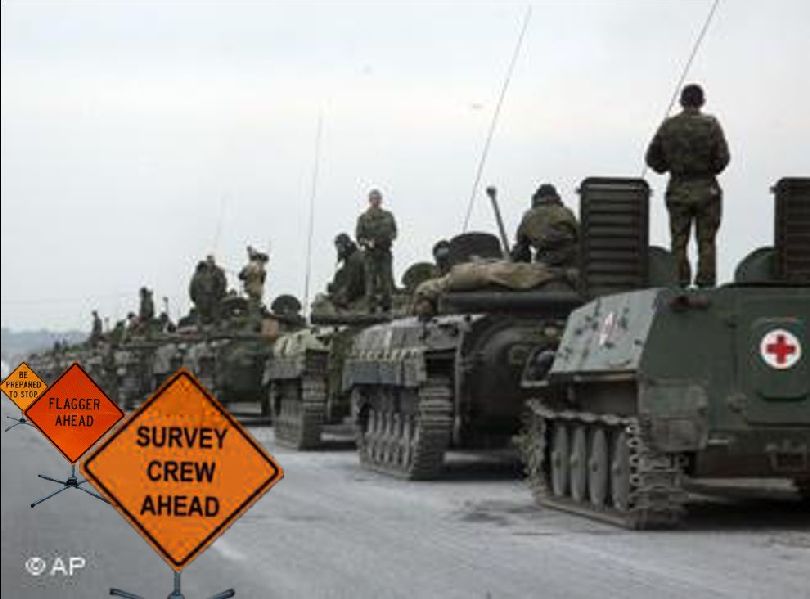
NATO Rapid Reaction Corps "Fast-track" Derailed by European Environment Agency
AP - BRUSSELS NATO's new rapid-reaction "spearhead" force, meant as a deterrent to Russian aggression, should be up and running with initial capabilities in less than a year, a top alliance official said Thursday.
The creation of a 4,000 to 5,000 troop response force, which will be able to respond to a crisis in eastern Europe within two to three days, was a key decision taken by NATO leaders earlier this month in Wales.
However, the European Environment Agency (EEA) says not so fast. Jock Martin, Head of Integrated Environmental Assessments (IEA), says that the environmental impact of any rapid reaction needs to be fully assessed before any deployment can be authorized.
“War is notoriously damaging to the health of the environment and the quality of life of those who live in and around it” says Martin. “We need to ensure that all future European wars are conducted in an environmentally sensitive manner so as to lessen the impact on fragile ecosystems.”
Martin says that while this may cause some concern for European diplomats, who are frustrated over the delays, due to the environmentally reckless behaviour of unnamed eastern European leaders “combating the inconsiderate lead of tyrants does not justify an environmental catastrophe.”
“What's the point of resisting an invading force if the environment is destroyed in the process?” Martin asks.
Peder Jensen, Head of Governance and Networks (GAN) at EEA, says he fully supports his colleague, Martin. “We need to be certain that the Rapid Reaction force is not an over-reaction to what is, essentially, a political disagreement. We at the EEA intend to show the world how Europe leads the way in environmentally sensitive warfare.”
Paul McAleavey, Head of Air and Climate Change (ACC) at EEA, responded by saying that air quality issues may be a deciding factor in the report to be issued, tentatively scheduled to be released in the summer of 2025. “We need to do a detailed study as to what the impact of countering an invasion will be on air quality. Poisonous gases and nuclear fallout can have serious implications for respiratory health, not to mention all the dust and smoke from conventional weaponry.”
A source within the agency, who declined to be identified for fear of reprisals, said, “There is no irony in the title Head of Air, as irony is 80% iron and therefore environmentally disastrous, due to destructive mining techniques, and, therefore, unacceptable within the agency. We are here to clean up Europe and irony is only an obstacle to that mission.”
When asked for a response to the news from Brussels, Russian President, Vladimir Putin stated, cryptically, “A few petro-dollars go a long way. We can talk about this in Madrid in a year.”
Spanish Prime Minister, Mariano Rajoy, said he was unaware of any talks scheduled with the Russian President.
9/23/2014, 1:56 pm
Kapitan Kangaroo Kourt
Fhalkyn wrote:MAY THE WARMONGERS' TANKS RUST IN HELL!
Tanks, comrade? There will be no tanks! We will ensure peace by setting an example! Electric cars and protests by environmentally conscious citizens, much like what occurred in New York City over the weekend, will shame belligerent leaders into accepting the dictates of the benevolent global network of environmental agencies. There will, finally, be peace in our time!
FORWARD!
9/23/2014, 11:01 pm
Captain Craptek
The History of Stuff
CHAPTER 236
Like a tidal surge the invading armies poured over the crumbling fortifications. In wave after wave they came, seemingly endless columns of tanks, artillery pieces and ruthless, battle hardened troops. The outnumbered, out gunned, war weary defenders fought bravely to hold their ground. But it was hopeless. One by one they began retreating, falling back to formerly held positions in the mountainous terrain high above their vanquished capitol city.
Suddenly the unmistakable whirring of helicopter blades cut the smoke filled air above the raging battle, and a voice so loud it startled defender and invader alike blared out. "You are trespassing on federal wildlife sanctuary property. Lay down your weapons. Get out of your tanks and place your hands on the vehicle where we can see them."
And so, the greatest war in history was brought to a halt by the lowliest of Gaia's creatures - the warm footed slimy cliff hopper toad.
The End
9/23/2014, 11:26 pm
Kapitan Kangaroo Kourt
Captain Craptek wrote:The History of Stuff
CHAPTER 236
Like a tidal surge the invading armies poured over the crumbling fortifications. In wave after wave they came, seemingly endless columns of tanks, artillery pieces and ruthless, battle hardened troops. The outnumbered, out gunned, war weary defenders fought bravely to hold their ground. But it was hopeless. One by one they began retreating, falling back to formerly held positions in the mountainous terrain high above their vanquished capitol city.
Suddenly the unmistakable whirring of helicopter blades cut the smoke filled air above the raging battle, and a voice so loud it startled defender and invader alike blared out. "You are trespassing on federal wildlife sanctuary property. Lay down your weapons. Get out of your tanks and place your hands on the vehicle where we can see them."
And so, the greatest war in history was brought to a halt by the lowliest of Gaia's creatures - the warm footed slimy cliff hopper toad.
The End
Inspiring literature, comrade Craptek. Indeed, how appropriate that dedicated bureaucrats should be responsible for the ending of hostilities in order to protect the lowest of the low: slimy toads. A rare species indeed. I believe that there are only 537 surviving in a small enclave on the border of Virginia and Maryland, though there are reports of the slimy toads surviving in less concentrated numbers, elsewhere in the country.
9/23/2014, 11:43 pm
Comrade Putout
[color=#C0392B]Captain Craptek[/color] didn't know it but he should have been crappin' in his pants/fur when he wrote:
And so, the greatest war in history was brought to a halt by the lowliest of Gaia's creatures - the warm footed slimy cliff hopper toad.
The End
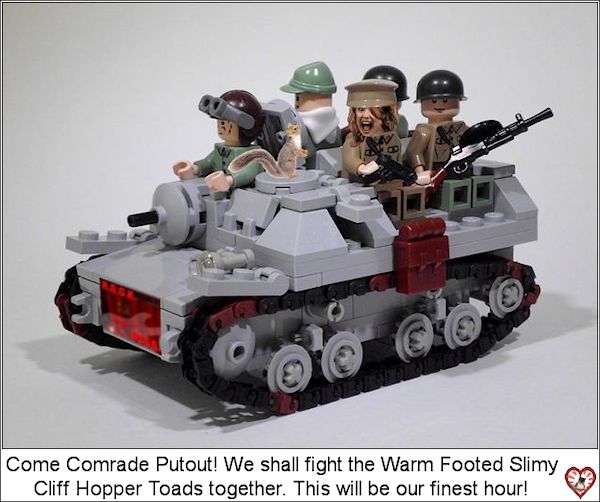
. The End indeed... they love squirrel meat and your disguise does not seem to have her fooled! .
.
9/24/2014, 1:31 am
Captain Craptek
Comrade Putout kindly volunteered to help when she wrote:
[color=#C0392B]Captain Craptek[/color] didn't know it but he should have been crappin' in his pants/fur when he wrote:
And so, the greatest war in history was brought to a halt by the lowliest of Gaia's creatures - the warm footed slimy cliff hopper toad. The End
. The End indeed... they love squirrel meat and your disguise does not seem to have her fooled!