4/7/2015, 12:28 pm
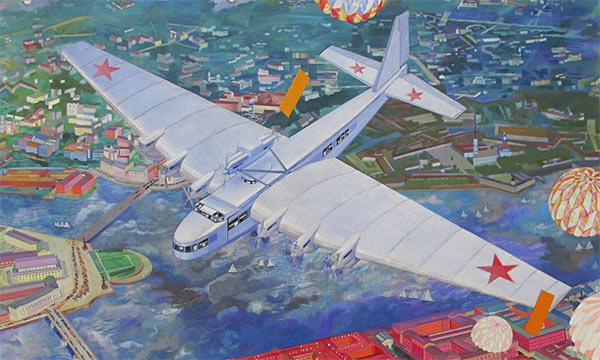
Decades before Twitter and Facebook, the Soviet state was a leader in perceptual manipulation technology. Meet the mighty flying propaganda machine of the 1930s: the Maxim Gorky.
The idea sounds like something straight out of the People's Cube bunker (which may or may not exist), and so we are not at liberty (which also may or may not exist) to discuss it. Let's just say that this works as an extended metaphor of the rise and fall of the USSR itself, or of any other utopian regime held together by a supersized propaganda apparatus (we are not at liberty to point fingers either).
Here is the skinny.
The cost of the plane was estimated at over 5 million rubles and its design was based on that of Junkers aircraft from Germany, like many Soviet aircraft at the time. Construction began in 1933.
The plans envisioned a printing press capable of producing 12,000 pages an hour, a darkroom, and a pneumatic post system and telephone switchboard for communications inside the aircraft. A loudspeaker system, named Voice from the Sky, would broadcast to people below.
Another proposal, which prompts the Twitter comparison, called for 18 illuminated letters to be affixed underneath the wings to beam messages from on high. Experts disagree on whether this was implemented. The other idea was to show various images and slogans on the clouds or on a special smoke curtain created by the aircraft itself, by means of a special projector apparatus. These images and short slogans should be of a size that can be seen and read from the earth at a distance of around two miles.
While the Maxim Gorky was being built, a propaganda squadron of smaller aircraft traversed the country. The Maxim Gorky, upon completion, was to be their flagship. The squadron touched down in towns and villages to deliver agitational messages and show movies. Pilots might take village elders aloft and point out to them that God was nowhere to be seen, helping to fulfill another Bolshevik goal, that of eradicating religion.
One of the propaganda sheets dispensed by the squadron was proudly headlined “Thrown from a plane of the Maxim Gorky Propaganda Squadron” and contained a panegyric to the Revolution with an appeal for increased production of hemp products. While the squadron may not have transformed the populace into dedicated Marxist-Leninists, it surely created the impression that the Party was the bearer of progress and enlightenment.
The Maxim Gorky crashed on May 18, 1935, having completed only 12 flights, while carrying its builders and their families on pleasure trips over Moscow. Two smaller planes accompanied it, by their presence emphasizing the size of the flagship, with Party-approved songs blaring from the Voice from the Sky speakers. In a maneuver that was later described as "aerial hooliganism," one of the smaller planes crashed into the gigantic right wing of the Maxim Gorky and both aircraft fell to the ground, killing everyone on board.
Read the full story here: The strange history of a futuristic Soviet propaganda plane.
~

The caption on the fantasy poster translated from Russian: Long live our happy socialist Motherland. Long live our beloved, great Stalin!
The letters on the wings say (from top to bottom) Vladimir Lenin, Iosif Stalin, Maxim Gorky, Mikhail Kalinin, Vyacheslav Molotov, etc. (yes, the same Molotov who later signed the 1939 Molotov-Ribbentrop peace treaty with the Nazi Germany that started WWII and whose name was additionally immortalized in the "Molotov cocktail," the gasoline-filled bottles that the Soviet soldiers threw at the German tanks in lieu of real weapons).
The idea sounds like something straight out of the People's Cube bunker (which may or may not exist), and so we are not at liberty (which also may or may not exist) to discuss it. Let's just say that this works as an extended metaphor of the rise and fall of the USSR itself, or of any other utopian regime held together by a supersized propaganda apparatus (we are not at liberty to point fingers either).
Here is the skinny.
The cost of the plane was estimated at over 5 million rubles and its design was based on that of Junkers aircraft from Germany, like many Soviet aircraft at the time. Construction began in 1933.
The plans envisioned a printing press capable of producing 12,000 pages an hour, a darkroom, and a pneumatic post system and telephone switchboard for communications inside the aircraft. A loudspeaker system, named Voice from the Sky, would broadcast to people below.
Another proposal, which prompts the Twitter comparison, called for 18 illuminated letters to be affixed underneath the wings to beam messages from on high. Experts disagree on whether this was implemented. The other idea was to show various images and slogans on the clouds or on a special smoke curtain created by the aircraft itself, by means of a special projector apparatus. These images and short slogans should be of a size that can be seen and read from the earth at a distance of around two miles.
While the Maxim Gorky was being built, a propaganda squadron of smaller aircraft traversed the country. The Maxim Gorky, upon completion, was to be their flagship. The squadron touched down in towns and villages to deliver agitational messages and show movies. Pilots might take village elders aloft and point out to them that God was nowhere to be seen, helping to fulfill another Bolshevik goal, that of eradicating religion.
One of the propaganda sheets dispensed by the squadron was proudly headlined “Thrown from a plane of the Maxim Gorky Propaganda Squadron” and contained a panegyric to the Revolution with an appeal for increased production of hemp products. While the squadron may not have transformed the populace into dedicated Marxist-Leninists, it surely created the impression that the Party was the bearer of progress and enlightenment.
The Maxim Gorky crashed on May 18, 1935, having completed only 12 flights, while carrying its builders and their families on pleasure trips over Moscow. Two smaller planes accompanied it, by their presence emphasizing the size of the flagship, with Party-approved songs blaring from the Voice from the Sky speakers. In a maneuver that was later described as "aerial hooliganism," one of the smaller planes crashed into the gigantic right wing of the Maxim Gorky and both aircraft fell to the ground, killing everyone on board.
Read the full story here: The strange history of a futuristic Soviet propaganda plane.
~
The caption on the fantasy poster translated from Russian: Long live our happy socialist Motherland. Long live our beloved, great Stalin!
The letters on the wings say (from top to bottom) Vladimir Lenin, Iosif Stalin, Maxim Gorky, Mikhail Kalinin, Vyacheslav Molotov, etc. (yes, the same Molotov who later signed the 1939 Molotov-Ribbentrop peace treaty with the Nazi Germany that started WWII and whose name was additionally immortalized in the "Molotov cocktail," the gasoline-filled bottles that the Soviet soldiers threw at the German tanks in lieu of real weapons).