10/2/2019, 10:12 pm
By "People's Will," I mean one of the revolutionary ancestors of the Bolshevik Party. People's Will was formed ostensibly out of compassion for the conditions of workers and peasants during the reign of Tsar Alexander II. Alexander is remembered for his role as the Great Liberator, the tsar who ended the practice of serfdom in Russia.
One would have thought that the People's Will would have rejoiced to see Alexander using his royal authority to bring an end to the practice of serfdom and make a way for improving the living standards and opportunities of Russia's peasants. What they saw instead was a threat to the existence of their party. If Alexander was really going to lift the peasantry out of serfdom, there was little reason for the existence of a revolutionary organization based essentially on the same idea.
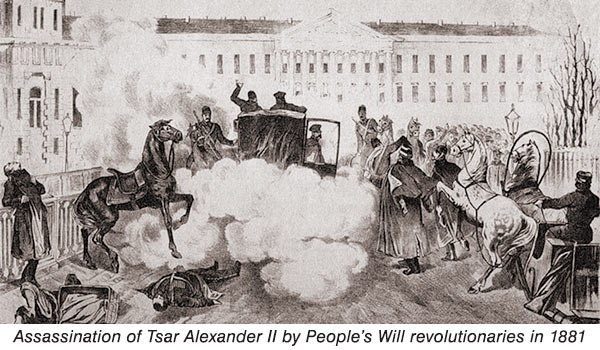
Because the existence of the party became paramount, and Alexander's reforms threatened them with obsolescence, the People's Will succeeded in assassinating Alexander in 1881.
A similar dynamic occurred with the successor to the People's Will, the infamous Bolshevik Party.
Before seizing power in 1917, the Bolsheviks had urged soldiers and sailors to disobey the orders of their officers. They promised reforms to improve the conditions of workers and peasants, and they promised rule by the soviets, the workers' councils. After seizing power, the Bolshevik leadership realized how tenuous was their hold on power, and immediately took steps to solidify their grip. Again, the existence of the party quickly surpassed the importance of reform and the driving concern was holding onto power. Now soldiers in the new Red Army were informed that disobedience to orders would mean the firing squad.
Lenin was later compelled to introduce his "New" Economic Policy (which one of his friends snarkily called the "Old" Economic Policy) to save an economy ravaged by war, revolution, and famine. It allowed a degree of private ownership and profit. In other words, Lenin had to reintroduce something like capitalism. Lenin realistically knew that workers' councils could not operate factories, but people with managerial experience could. So the idea of a ruling proletariat was quickly abandoned and specialists who knew how to run large and complex operations were put in their place. For a time, bourgeois factory managers were reinstated by the Party that stood for the dictatorship of the Proletariat.
Of course, they also resorted to terror through the Extraordinary, understood to mean temporary, Commission, the CheKa. That there was nothing temporary about the CheKa is well known as it morphed into the NKVD and later the KGB. Under Stalin, terror would mean the arbitrary murdering of innocent civilians, former friends, and government officials to numbers that can only be estimated today.
Today's Democrats have been promoting themselves as the party of minorities, the marginalized, and others who identify as oppressed in some way. One would think they would have rejoiced at a Trump presidency. Trump did not take minorities for granted as Democrats do, nor did he ignore them as Republicans do. Trump proactively met with minority business leaders and clergy to hear from them first hand. He enacted policies that have driven minority unemployment to record lows. He has done more for minorities in two years than the Democrats have done for the same people groups in decades.
But, like the People's Will of the 19th Century, the existence of the party comes first, and Trump is a serious threat to the relevance of the Democrat Party. Out of an irrational blend of rage and fear they have strained for a reason - any reason - to remove Trump from office. They have attempted to create a baseless narrative of Russian election meddling, they have attempted to invoke the XXV Amendment arguing that Trump is mentally unfit for office, and now there's an attempt to impeach Trump on charges so flimsy that they resemble the articles of impeachment against Andrew Johnson.
It's trendy among the left to conjure up Hitler, make absurd comparisons to Trump, and then to wail history-is-repeating-itself-I'm-so-frightened-for-my-country, etc. Yet history is repeating itself.
By their tacit approval of violence and exhibitions of the assassination of the president, the call for gun confiscation, the embracing of openly socialist economic policies, and the refusal to admit the humanity of unborn children, the Democrats are looking more and more like the successors to the Bolsheviks, and for many of the same reasons.
One would have thought that the People's Will would have rejoiced to see Alexander using his royal authority to bring an end to the practice of serfdom and make a way for improving the living standards and opportunities of Russia's peasants. What they saw instead was a threat to the existence of their party. If Alexander was really going to lift the peasantry out of serfdom, there was little reason for the existence of a revolutionary organization based essentially on the same idea.
Because the existence of the party became paramount, and Alexander's reforms threatened them with obsolescence, the People's Will succeeded in assassinating Alexander in 1881.
A similar dynamic occurred with the successor to the People's Will, the infamous Bolshevik Party.
Before seizing power in 1917, the Bolsheviks had urged soldiers and sailors to disobey the orders of their officers. They promised reforms to improve the conditions of workers and peasants, and they promised rule by the soviets, the workers' councils. After seizing power, the Bolshevik leadership realized how tenuous was their hold on power, and immediately took steps to solidify their grip. Again, the existence of the party quickly surpassed the importance of reform and the driving concern was holding onto power. Now soldiers in the new Red Army were informed that disobedience to orders would mean the firing squad.
Lenin was later compelled to introduce his "New" Economic Policy (which one of his friends snarkily called the "Old" Economic Policy) to save an economy ravaged by war, revolution, and famine. It allowed a degree of private ownership and profit. In other words, Lenin had to reintroduce something like capitalism. Lenin realistically knew that workers' councils could not operate factories, but people with managerial experience could. So the idea of a ruling proletariat was quickly abandoned and specialists who knew how to run large and complex operations were put in their place. For a time, bourgeois factory managers were reinstated by the Party that stood for the dictatorship of the Proletariat.
Of course, they also resorted to terror through the Extraordinary, understood to mean temporary, Commission, the CheKa. That there was nothing temporary about the CheKa is well known as it morphed into the NKVD and later the KGB. Under Stalin, terror would mean the arbitrary murdering of innocent civilians, former friends, and government officials to numbers that can only be estimated today.
Today's Democrats have been promoting themselves as the party of minorities, the marginalized, and others who identify as oppressed in some way. One would think they would have rejoiced at a Trump presidency. Trump did not take minorities for granted as Democrats do, nor did he ignore them as Republicans do. Trump proactively met with minority business leaders and clergy to hear from them first hand. He enacted policies that have driven minority unemployment to record lows. He has done more for minorities in two years than the Democrats have done for the same people groups in decades.
But, like the People's Will of the 19th Century, the existence of the party comes first, and Trump is a serious threat to the relevance of the Democrat Party. Out of an irrational blend of rage and fear they have strained for a reason - any reason - to remove Trump from office. They have attempted to create a baseless narrative of Russian election meddling, they have attempted to invoke the XXV Amendment arguing that Trump is mentally unfit for office, and now there's an attempt to impeach Trump on charges so flimsy that they resemble the articles of impeachment against Andrew Johnson.
It's trendy among the left to conjure up Hitler, make absurd comparisons to Trump, and then to wail history-is-repeating-itself-I'm-so-frightened-for-my-country, etc. Yet history is repeating itself.
By their tacit approval of violence and exhibitions of the assassination of the president, the call for gun confiscation, the embracing of openly socialist economic policies, and the refusal to admit the humanity of unborn children, the Democrats are looking more and more like the successors to the Bolsheviks, and for many of the same reasons.