10/12/2005, 8:26 pm
A collection of stories about Che's photo...
"This is a revolution! And a revolutionary must become a cold killing machine motivated by pure hate."
Che Guevara
* * *
This story used to be here on CNNbut is no longer available.
Che Guevara's family to fight use of famed photo
Monday, August 29, 2005 Posted: 1335 GMT (2135 HKT)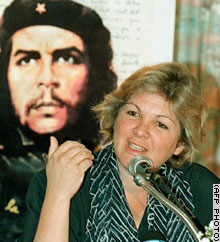
Aleida Guevara in front of the icon image of her father in a 1997 photo.
The image of the Argentine-born guerrilla gazing sternly into the distance, long-hair tucked into a beret with a single star, has been an enduring 20th century pop icon.
The picture -- taken by a Cuban photographer in 1960 and printed on posters by an Italian publisher after Guevara's execution in Bolivia seven years later -- fired the imagination of rioting Parisian students in May 1968 and became a symbol of idealistic revolt for a generation.
But as well as being one of the world's most reproduced, the image has become one of its most merchandised. And Guevara's family is launching an effort to stop it. They plan to file lawsuits abroad against companies that they believe are exploiting the image and say lawyers in a number of countries have offered assistance.
"We have a plan to deal with the misuse," Guevara's Cuban widow Aleida March said in an interview.
"We can't attack everyone with lances like Don Quixote, but we can try to maintain the ethics" of Guevara's legacy, said March, who will lead the effort from the Che Guevara Studies Center which is opening in Havana later this year.
"The center intends to contain the uncontrolled use of Che's image. It will be costly and difficult because each country has different laws, but a limit has to be drawn," the legendary guerrilla's daughter, Aleida Guevara, told Reuters.
Swatch has used Guevara on a wristwatch. Advertising firms have used his image to sell vodka. Supermodel Gisele Bundchen even took to the runway in Brazilian underwear stamped with Che's face.
Guevara collectibles -- from Zippo lighters to belt buckles and key chains -- can be bought online at thechestore.com.
But a successful copyright lawsuit against Smirnoff vodka in Britain in 2000 set the precedent for legal action, establishing ownership of the photographic image.
Lawyers say it will be an uphill struggle to deter non-photographic use of such a widely reproduced image, other than in countries like Italy where laws protect image rights.
The famous picture was shot by Alberto Diaz, a fashion photographer better known as Korda, at a funeral for victims of the explosion of a French freighter transporting weapons to Cuba one year after Fidel Castro's revolution triumphed with the help of Guevara.
Korda's group photograph was not printed by his newspaper the next day. Seven years later, when Italian publisher Giangiacomo Feltrinelli showed up looking for a cover picture for an edition of Che's "Bolivian Diary," Korda gave him two prints for free.
Guevara was captured six months later in the Bolivian jungle, where his bid to start an armed peasant revolution ended in fiasco. On news on his death, Feltrinelli cropped the photo and published large posters that quickly sold 1 million copies.
The guerrilla fighter was transformed into martyr, pop celebrity and radical chic poster boy.
Korda said he never received a penny from Feltrinelli.
But a year before his death in 2001, the photographer won a lawsuit against London agency Lowe Lintas for unauthorized use of the picture in a Smirnoff vodka advertising campaign. The Smirnoff brand is now owned by Britain's Diageo.
Korda later donated the $70,000 award to children's health care in communist Cuba.
Razi Mireskandari, the London lawyer who filed the copyright case, said Korda worried that the image of Che, who did not drink, was being trivialized by its use in promoting a alcoholic beverage that bore no relation to Cuba or his political message.
"We felt there were so many people you could take action against that we had to start somewhere," Mireskandari said. "The plan of action was to target one of these, which was Smirnoff, and then, when we got the judgment, we were going to go against everyone else," he said in a telephone interview.
After the photographer's death, his heirs never contacted the lawyer for further action and are disputing among themselves copyright ownership of the famous picture.
Korda's daughter Diana Diaz has continued to fight political misuse of the picture.
In 2003 she won a lawsuit against a Paris-based press rights group for using the Che photograph in a poster campaign aimed at dissuading French tourists from vacationing in Cuba after the jailing of 29 dissident journalists.
Reporters Without Borders had superimposed Che's face on a picture of a baton-wielding riot policeman. The caption said: "Welcome to Cuba, the world's largest jail for journalists."
Che fever was stoked last year by "The Motorcycle Diaries," a film about his eye-opening trip through poverty-stricken countries of South America as a medical graduate.
Even Cuba sells Che's image. Postcards and posters of Guevara playing golf at the Country Club shortly after the overthrow of dictator Fulgencio Batista in 1959 are popular with tourists.
So are Cuban banknotes issued when Guevara was Central Bank governor, simply signed "Che."
* * *
This story is still available in CNN archives - but I thought it better to post here to prevent it from disappearing.Photographer wins copyright on famous Che Guevara image
LONDON (AP) -- Social justice, si. Vodka advertisements, no.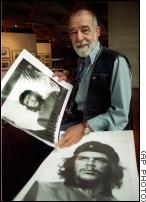
Taken in 1960, the photo of Guevara -- with long curly hair, a tilted beret and a dark, intense gaze -- became a revolutionary icon. One of the world's most widely reproduced images, it appeared on countless T-shirts and posters.
Throughout the years, photographer Alberto Diaz Gutierrez, who goes by the professional name Alberto Korda, never made any money from the use of his famous picture. His motives in bringing the lawsuit were not financial, he said.
"As a supporter of the ideals for which Che Guevara died, I am not averse to its reproduction by those who wish to propagate his memory and the cause of social justice throughout the world," he said. "But I am categorically against the exploitation of Che's image for the promotion of products such as alcohol, or for any purpose that denigrates the reputation of Che."
The 72-year-old Diaz Gutierrez spoke to reporters at a London exhibition of Cuban photography. He and supporters stood in front of a print of the famous picture to toast their legal victory -- with Cuban rum.
The lawsuit was filed in August by the London-based Cuba Solidarity Campaign on Diaz Gutierrez's behalf against the photo agency Rex Features Ltd. and the advertising agency Lowe Lintas Ltd.
The amount of the settlement, approved by the High Court on Thursday, was not disclosed. Lawyer Simon Goldberg said the ruling's real significance lay in the fact that the court had asserted Diaz Gutierrez's copyright.
"The declaration of copyright which the court affirmed will send a clear message to those who reproduce photographic images which they wrongly consider to be in the public domain without the copyright owner's consent," he said.
Rex Features and Lowe Lintas had no comment other than a joint statement, signed by all the parties, saying the claim had been "sensibly and amicably resolved."
When the suit was filed, Lowe Lintas, then known as Lowe Howard-Spink, said it had acquired use of the Guevara image through Rex Features in good faith, and denied infringement of any copyright.
Diaz Gutierrez, who lives in Havana, had complained that the ad, for a spicy vodka, trivialized the historic importance of his photograph. The image was superimposed on a hammer and sickle motif, with a chili pepper used to depict the sickle.
The photo of a steely-eyed Che, whose real name was Ernesto Guevara, was taken March 5, 1960, at a memorial service for more than 100 crew members of a Belgian arms cargo ship killed in an attack Cuba blamed on counterrevolutionary forces aided by the United States.
The Argentine-born Guevara was a key figure in Cuba's 1959 revolution, alongside Fidel Castro. When he was killed by the Bolivian army in October 1967, he was hailed a martyr of the revolution.
Diaz Gutierrez said he would donate the settlement and any other proceeds from the photograph to children's medical care in Cuba.
* * *
This story is still available on the BBC site - but again better be safe than sorry:Saturday, 26 May, 2001, 00:28 GMT 01:28 UK
Che Guevara photographer dies
Alberto Korda, the photographer who took the picture of Che Guevara that became an icon of left-wing revolutionaries and students worldwide, has died aged 72.
Korda, whose real name was Alberto Diaz Gutierrez, suffered a heart attack while in Paris for an exhibition of his works.
It's a great loss for Cuban culture. He was one of the top chroniclers of the revolution
Photographer Liborio Noval

Korda later worked as Castro's personal photographer.
"It's a great loss for Cuban culture. He was one of the top chroniclers of the revolution," said fellow Cuban photographer Liborio Noval.
Two shots
Korda took the photo for which he will be best remembered at a memorial service in March 1960.
Che Guevara stepped onto the podium and scanned the crowd. Korda snapped two quick shots, including the legendary one of the revolutionary with his beret, gazing like a prophet into the distance.
Revolucion rejected the photo, instead running pictures of Castro and the French writers Jean-Paul Sartre and Simone de Beauvoir.
But Korda recognised its greatness and kept the photo tacked to his wall for seven years, until an Italian journalist saw it.
Korda allowed the Italian to take it, and when Che Guevara was killed a few months later, it was published as a poster in Italy.
It immediately became one of the most recognisable images of leftist revolution, and has been reproduced on countless T-shirts, banners and posters since.
No profits
Although Korda kept the negative and the camera with which he took the photo, he never received royalties for the picture that the Maryland Institute of Art called "the most famous photograph in the world and a symbol of the 20th century".
He was happy to see it used as a revolutionary banner - but when a vodka company used it in an advertisement last year, Korda drew the line.
He filed suit in London.
"As a supporter of the ideals for which Che Guevara died, I am not averse to its reproduction by those who wish to propagate his memory and the cause of social justice throughout the world," Korda said in the autumn of 2000.
"But I am categorically against the exploitation of Che's image for the promotion of products such as alcohol, or for any purpose that denigrates the reputation of Che."
Korda won an out-of-court settlement of about $50,000, which he donated to the Cuban medical system.
"If Che were still alive, he would have done the same," Korda told the Reuters news agency.
Korda's other memorable photos include shots of the victorious rebels arriving in Havana and Quixote of the Lamp Post, which shows a Cuban man sitting on a lamp post in a sea of people listening to a Castro speech.
He photographed Castro playing golf and fishing with Guevara, in the company of writer Ernest Hemingway, and staring at a tiger in a New York zoo.


