There are astounding similarities between the United States during the period 1967/1968, and 2019/2020.
NORTH KOREA
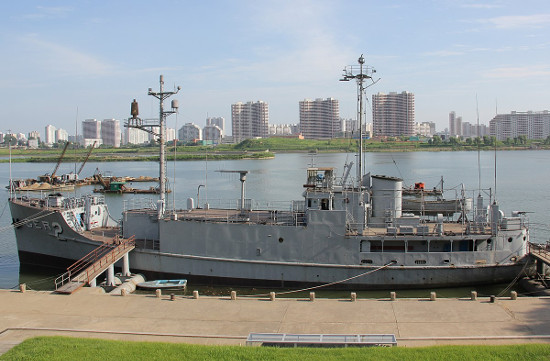
1968: January 23: Some 15 years after the Korean War, the still-tenuous relations between North Korea and the United States gave way to crisis after North Korea captured the Navy intelligence vessel USS Pueblo and its crew. U.S. authorities claimed the ship had been in international waters in the Tsushima Strait, but North Korea disagreed, and held the 83 crew members in a POW camp before the two countries could negotiate their release.
2020: President Trump crosses into North Korea (2019), meets with NK leader, Kim Jong Un
In an attempt to end this 70-year old conflict, President Donald Trump became the first sitting U.S. president to set foot on North Korean soil when he walked over into the Demilitarized Zone that divides the Korean peninsula. It was there that Trump held an impromptu and historic meeting with North Korean leader Kim Jong Un.
After the roughly 45-minute-long meeting, Mr. Trump told reporters he and Kim had agreed to restart negotiations in the hopes of brokering a deal to start the full denuclearization of the peninsula -- a long-sought and elusive foreign policy goal of American administrations for decades. The president, who hailed his "great relationship" with the North Korean strongman, invited Kim to the White House to continue talks.
Through an interpreter, Kim told Mr. Trump, "I never expected to meet you in this place."
Note: Technically, the Korean War has been going on for 70-years (1950-Present). An Armistice was signed in 1953 which is a formal agreement of warring parties to stop fighting. It is not necessarily the end of a war, as it may constitute only a cessation of hostilities while an attempt is made to negotiate a lasting peace.
No peace treaty has ever been signed by the United States nor the North Koreans!
Pandemics
1968: Hong Kong Flu
This influenza pandemic occurred in 1968 with the Hong Kong Flu (H3N2) outbreak, which resulted in nearly 34,000 deaths in the United States. The 1968/69 pandemic, which was milder than 1957, is thought to have caused around 1 million deaths worldwide. In early 1968, the Hong Kong influenza pandemic was first detected in Hong Kong. It then spread worldwide during the following two winters, causing greater morbidity in some countries the first winter and others the second. The first cases in the US were detected as early as September of 1968, but illness did not become widespread in the US until December 1968. Deaths from this virus peaked in December 1968 and January 1969. Those over the age of 65 were most likely to die. The same virus returned a year later, in late 1969 and early 1970 [peaking in the UK in January 1970] and in 1972. The number of deaths between September 1968 and March 1969 for this pandemic was 33,800, making it the mildest pandemic in the 20th century.
1968 flu pandemic, also called Hong Kong flu pandemic of 1968 or Hong Kong flu of 1968, global outbreak of influenza that originated in China in July 1968 and lasted until 1969–70. The outbreak was the third influenza pandemic to occur in the 20th century; it followed the 1957 flu pandemic and the influenza pandemic of 1918–19. The 1968 flu pandemic resulted in an estimated one million to four million deaths, far fewer than the 1918–19 pandemic, which caused between 25 million and 50 million deaths.
2020: Coronavirus
Coronavirus disease 2019/2020 (COVID-19) is a virus (more specifically, a coronavirus) identified as the cause of an outbreak of respiratory illness first identified in Wuhan City, Hubei Province, China.
Note: The Coronavirus has shut down not only much of the United States, it has also shut down many other countries.
Assassination/Killings
1968: The assassination of Martin Luther King
While in Memphis to support striking sanitation workers in that city, the civil rights leader Dr. Martin Luther King, Jr. gave a sermon in which he told listeners: “I've seen the Promised Land. I may not get there with you. But I want you to know tonight that we, as a people, will get to the Promised Land.” The following evening, Martin Luther King was assassinated while he was standing on the balcony outside his room at a Memphis motel.
As news of King's murder sparked rioting in dozens of cities across the country, an international manhunt for his shooter, James Earl Ray, ended in his capture in London. Ray was convicted, and died in prison in 1998.
2020: George Floyd killed in Minneapolis
On May 25, 2020, George Floyd, an African-American man, was killed in the Powderhorn community of Minneapolis, Minnesota. While Floyd was handcuffed and lying face down on a city street during an arrest, Derek Chauvin, a white American Minneapolis police officer, kept his knee on the right side of Floyd's neck for 8 minutes and 46 seconds; according to the criminal complaint against Chauvin, 2 minutes and 53 seconds of that time occurred after Floyd became unresponsive. Officers Tou Thao, J. Alexander Kueng, and Thomas K. Lane participated in Floyd's arrest, with Kueng holding Floyd's back, Lane holding his legs, and Thao looking on and preventing intervention by an onlooker as he stood nearby.
In the week that followed George Floyd's death, riots broke out in Minneapolis, Chicago, New York City, Baltimore, Los Angeles, and in many other cities and states.
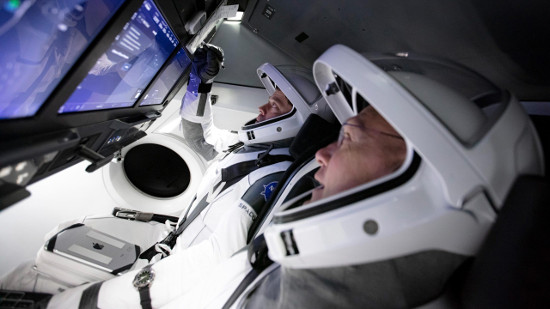
2020:NASA astronauts Bob Behnken and Doug Hurley are riding on Demo-2, which will be the first orbital crewed mission to launch from the United States since NASA's space shuttle fleet was grounded in July 2011. Since then, Russian Soyuz spacecraft have been the only ride to and from orbit for American astronauts, and everyone else as well.
RIOTS
In 1968 riots occurred in Chicago (IL), Detroit (MI), Newark (NJ), Baltimore (MD), Wilmington (DE), Cincinnati (OH), and many other cities across the United States.
1968: Riots across America
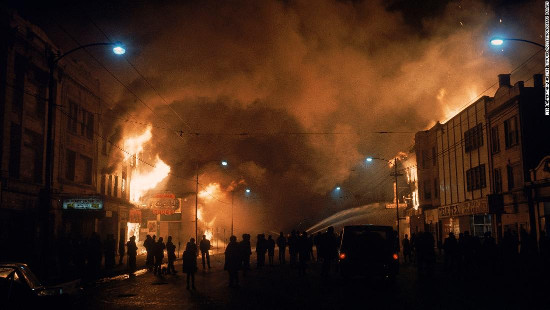
The 1968 Chicago riots, in the United States, were sparked in part by the assassination of Martin Luther King, Jr. Violence and chaos followed, with people flooding out onto the streets of major cities. Soon riots began, primarily in black urban areas. Over 100 major U.S. cities experienced disturbances, resulting in roughly $50 million in damage.
Rioters and police in Chicago - ironically a place of which King himself said “I've been in many demonstrations all across the South, but I can say that I have never seen, even in Mississippi and Alabama, mobs as hostile and as hate-filled as I'm seeing in Chicago” - were particularly aggressive, and the damage was severe. Of the 39 people who died in the nationwide disturbances, 34 were black. Chicago, Baltimore, and Washington, D.C. experienced some of the worst riots following King's assassination. In Chicago itself, more than 48 hours of rioting left 11 Chicago citizens dead, 48 wounded by police gunfire, 90 policemen injured, and 2,150 people arrested. Three miles of East Garfield Park and West Garfield Park on West Madison Street were left in a state of rubble.
Later the same year, around the Democratic National Convention, Chicago would once again be a place for political protest and clashes with the authorities.
Riots
On April 5, 1968, violence sparked on the West side of Chicago, gradually expanding to consume a 28-block stretch of West Madison Street and leading to additional damage on Roosevelt Road. The Austin and Lawndale neighborhoods on the West Side, and the Woodlawn neighborhood on the South Side experienced the majority of the destruction and chaos.
The rioters broke windows, looted stores, and set buildings (both abandoned and occupied) on fire. Firefighters quickly flooded the neighborhood, and Chicago's off-duty firefighters were told to report to work. There were 36 major fires reported between 4:00 pm and 10:00 pm alone. The next day, Mayor Richard J. Daley imposed a curfew on anyone under the age of 21, closed the streets to automobile traffic, and halted the sale of guns or ammunition.
Approximately 10,500 police were sent in, and by April 6, more than 6,700 Illinois National Guard troops had arrived in Chicago with 5,000 soldiers from the 1st Armored and 5th Infantry Divisions being ordered into the city by President Johnson. The general in charge declared that no one was allowed to have gatherings in the riot areas and authorized the use of tear gas. Mayor Richard J. Daley gave police the authority "to shoot to kill any arsonist or anyone with a Molotov cocktail in his hand ... and ... to shoot to maim or cripple anyone looting any stores in our city."
The South Side had escaped the major chaos mainly because the two large street gangs, the Blackstone Rangers and the East Side Disciples, cooperated to control their neighborhoods. Many gang members did not participate in the rioting, due in part to King's direct involvement with these groups in 1966.
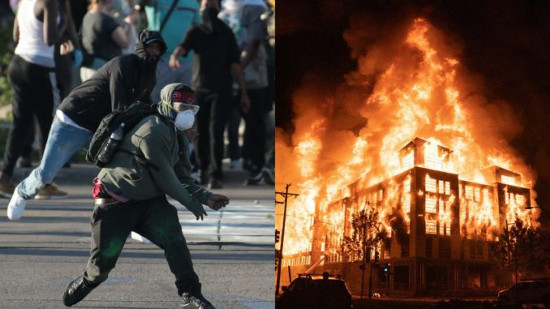
2020: Riots began in Minneapolis, Minnesota after the death of George Floyd. These riots quickly spread to all parts of the United States causing millions of dollars in damage, the loss of hundreds of businesses, and the destruction by fire of low income housing.
Riots occurred in Minneapolis, Chicago, Baltimore, Seattle, Salt Lake City, New York City, Philadelphia, Portland, Oregon, Denver, Nashville, Beverly Hills, California, Flint, Michigan, and many other locations throughout the United States.
1968: Chicago Seven, group of political activists who were arrested for their antiwar activities during the August 1968 Democratic National Convention in Chicago, Illinois. A series of riots occurred during the convention, and eight protest leaders—Abbie Hoffman and Jerry Rubin, cofounders of the Youth International Party (Yippies); Tom Hayden, cofounder of Students for a Democratic Society (SDS); Black Panther Chairman Bobby Seale, the only African American of the group; David Dellinger and Rennie Davis of the National Mobilization Committee to End the War in Vietnam (MOBE); and John Froines and Lee Weiner, who were alleged to have made stink bombs—were tried on charges of criminal conspiracy and incitement to riot.
2020: The Bernie Bros state they will wreak havoc
Bernie Sanders organizer Kyle Jurek
“Germany had to spend billions of dollars re-educating their f***ing people to not be Nazis,” he continues. “We're probably going to have to do the same f***ing thing here.”
“That's kind of what all Bernie's whole f***ing like, ‘hey, free education for everybody' because we're going to have to teach you to not be a f***ing Nazi,” he added.
In another part of the video, Jurek is seen discussing Soviet Union dictator Joseph Stalin's use of gulags, where he claims that the CIA was overly critical of them. “People were actually paid a living wage in the gulags, they conjugal visits in gulags, gulags were meant for re-education.”
Martin Weissgerber, South Carolina Field Organizer, Sanders Campaign:
I'm ready… I'm ready to start tearing bricks up and start fighting… I'm not – No cap, bro. I'll straight up – I'll straight up get armed, I want to learn how to shoot, and go train. I'm ready for the f*cking revolution, bro… I'm telling you. Guillotine the rich.”
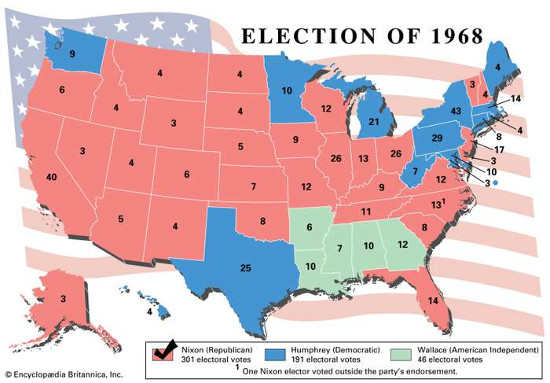
The race tightened in the last weeks after Johnson halted air attacks on North Vietnam, which benefited Humphrey. But Nixon triumphed on Election Day with a comfortable electoral college lead (despite a razor-thin margin of victory in the popular vote). The third-party candidate George Wallace, a former Alabama governor, captured 13.5 percent of the popular vote and five southern states.
The American presidential election was held on November 5, 1968, in which Republican Richard M. Nixon defeated Democrat Hubert H. Humphrey.
2020: President Donald Trump runs for reelection
Yet to be determined...
6/2/2020, 6:03 pm
Genosse Dummkopf
.
SPACE
1968 & 2020 : In BOTH cases - Apollo 8 and Demo-2 - the astronauts were active denialists of respirative self-condomization!
Outrage!
... and, to add some local touch:
PROGRESS
1968 : Komrade Direktor, by then a newbie schoolboy, in a country plainly leading the March to Kommunizm, dreams of contributing to стенгазеты - styengazyety, "wall newspapers" in classrooms, "edited" by pupils under teachers' guidance - by embellishing them with beautiful graphical elements, symbolizing the soon coming Светлое Будущее (Glorious Future), embodied by Red Stars and many many heads of comrades Lenin and Stalin.
2020 : Komrade Direktor, now somewhat antipodally located, in a country plainly dreaming of March to Kommunizm, leads a вебгазета - vyebgazyeta, "wall newspaper" in the Web - embellished with beautiful graphical elements, symbolizing the soon coming Светлое Будущее (Glorious Future), embodied by Red Stars and many many heads of comrades Lenin and Stalin.
6/2/2020, 7:14 pm
Ivan the Stakhanovets
1968: Grandmother gave me $9 for my birthday, I kept it in a coffee can under the bed.
2020: 401k worth about 9 bucks.
6/3/2020, 7:54 am
RedDiaperette
[OFF]
1968 - I was working in midtown Manhattan. We had bomb scares so often that it became an office joke to talk about where we'd go shopping next time the building was evacuated. After the all-clears, we returned to our offices and continued working. And joking.
2020 - I live downtown in a large midwest city. We have a virus epidemic that turns out to be no worse than previous virus epidemics. No one jokes. No one shops. No one is permitted to shop, except in select stores under increasingly restrictive conditions. People cower in their homes (some more afraid of government enforcement agencies than of the virus), wear masks, flinch away from anyone closer than six feet away. Businesses, small stores, restaurants, bars, fitness centers are evacuated permanently. As the threat from the virus decreases, restrictions by the government increase. Then, suddenly, there are riots. Riots that have nothing to do with the virus or indeed with our city. But no matter. The riots are the only social events that are permitted -- and, indeed, encouraged. One wonders: was this, too, planned?